Why i had to Write Marketing On Steroids!
Updated: Jan 21
Only a crazy man would think of becoming a successful author in this world where attention span is diminishing by the day!Wanna know what's crazier? Expecting to be a successfull author in Tanzania!
Yet here i am writing this post just days after releasing my first book!(Marketing On Steroids : A Guide To An Unfair Advantage In The Marketplace) Call me mad,naive,foolish etc and i honestly wouldn't blame you!
You see Tv then later on the Internet exposed me to the western marketing extravaganza,the friendly and sometimes fierce rivarly between western brands that brought about some of the best and most memorable advertising campaigns the world has ever seen and the great tv shows and movies that were made to dramatize it all really made me wish that this could be replicated in my country(Tanzania)
But it didn't,all i saw was mundane branding,missed opportunities at taking a jibe at a competitor,wasteful marketing campaigns that payed no attention to consumer behavior etc
So i kept waiting for someone to rise up and shape how marketing could be used cunningly not just in business but in good worthy causes like charity,road safety etc but no one stepped up
So in 2023 i began to take matters into my own hands and began doing rather than wishing!
My recent posts on linkedin would best describe my journey :
How do you write to people who don't read?
This has made me ignore writing anything over the years(see image 😃 ),being an advertising man hasn't helped!
You see success to writing great advertising copy is in omission rather than addition of words!
'If it's not working for you,it's working agains't you!' - Harry Dry
But with so much to say,it was impossible to keep it all inside!
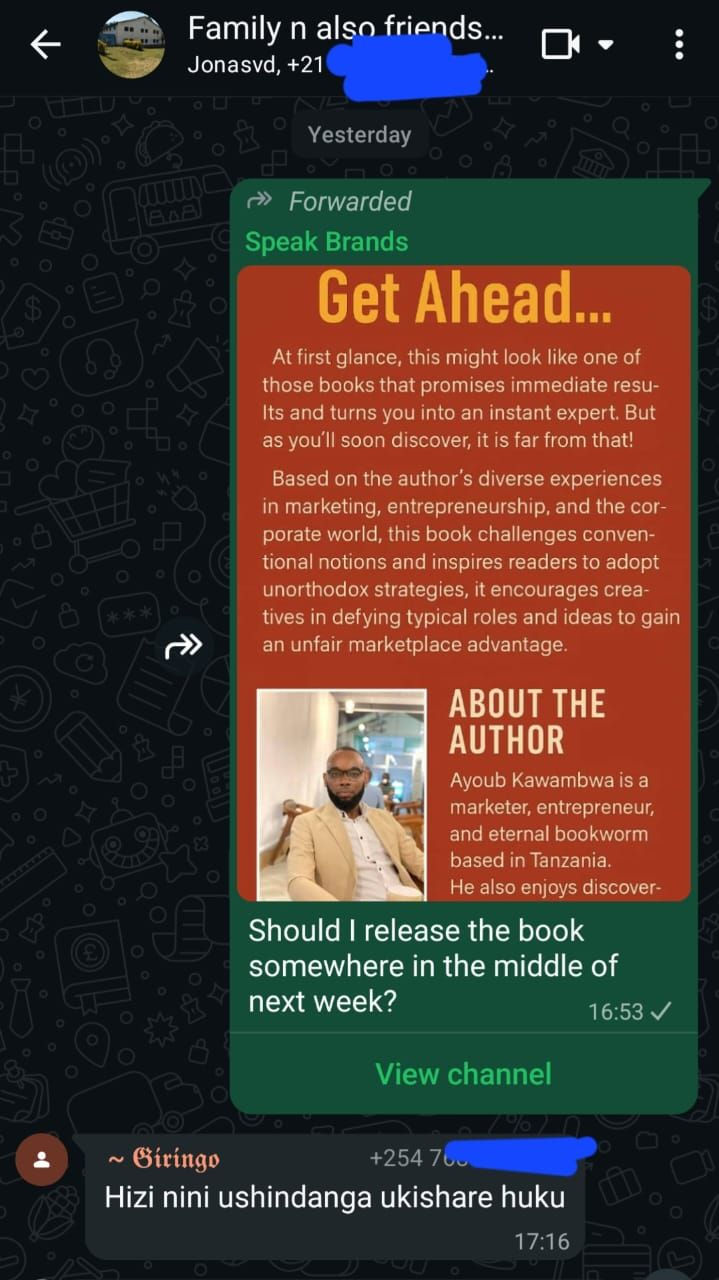
So as a hobby i started the 'Speak Brands' Whatsapp Channel which i like to call 'Tanzania's largest library of ads' Where i got to write on different strategies of coming up with a successful advertising campaign with examples
Just like that a side hustle was born and i got to work with some exciting businesses and individuals!
But still some folks felt left out,especially the ones who wanted to learn something but didn't have time to go through thousands of posts on my social media and also didn't have the resources to hire me for consultation!
So how do i cater for this group of individuals?How do i bring order and clarity to the hundreds of concepts i shared before?How do i share the little experience i learnt in the world of business & marketing to this group of individuals?
A book/guide felt inevitable!
I am proudly announcing that in the coming week or weeks 'MARKETING ON STEROIDS : A Guide To An Unfair Advantage In The Marketplace' will be made public!
It's meant to save you a great deal of time and money in wasteful marketing research,campaigns & strategies!
If you can get it right at the first attempt,wouldn't that be great?
Why the name Marketing On Steroids?
I have been hitting the gym for years but it is only recently that i have started receiving a little bit of praise for my hard work! Contrast that to some young online artist coming out of nowhere with a hit single and in the next record they are topless showcasing a 'six-pack' while i have been struggling to get my belly flat for years in the gym!Not fair,right?
So is the business world,and good marketing that takes into account consumer behavior and psychology is the steroid that gives unfair advantage to the businesses that dominate their respective markets!
This is best illustrated by my other recent linkedin post :
Global Search Engine Market Share (All Devices - Dec 2025):
Google: ~90.82%
Bing: ~4.03%
Yandex: ~1.57%
Yahoo!: ~1.26%
DuckDuckGo: ~0.78%
Baidu: ~0.66%
Guess what,i googled that!
You see most business owners and executives believe that the business world is fair and that as long as there is a market we will share the market share!
Only fools still believe this,no offense!
Which is why i led with the above example,market share,company sizes,wealth etc cannot be forecasted by averages/fairness,they operate in the 'Extremistan' realm as Nassim Talem puts it 'If you are dealing with quantities from Extremistan, you will have trouble figuring out the average from any sample since it can depend so much on one single observation. The idea is not more difficult than that. In Extremistan, one unit can easily affect the total in a disproportionate way. In this world, you should always be suspicious of the knowledge you derive from data.'
As vividly demonstrated by the above example,if you were to look at the average figure on the market size for search engines,the results would greatly mislead you since one company has completely dominated the segment!
I have witnessed great businesses(with great advertising eg duck duck campaign,image attached) that have done nothing wrong!fail miserably due to this great 'Imbalance',which made me dedicate my time to tracking what needs to be done to be on the 'lucky' side of things and most include study of consumer behavior and really understading it hence coming up with campaigns that may not sit well with your corporate boss!😃

In other words i came up with a playbook that wants business owners and executives to Zig while the market Zags!In the form of a Book - Marketing On Steroids : A Guide To An Unfair Advantage In The Market Place 👉 https://www.marketingonsteroidsbooks.com/
After all what do you have to lose?,you only command a meagre 0.66% of the marketshare! doing things differently might not be such a bad idea afterall!
So i welcome you to grab a copy of the book and get that edge over your competitor,and with that set in moion the kind of vibrant and creative atmosphere we have all admired from afar!
Please feel free to subscribe to my upcoming linkedin newsletter(Marketing On Steroids Dissect) which will be dissecting the different concepts and examples suggested in the book Subscribe on LinkedIn https://www.linkedin.com/build-relation/newsletter-follow?entityUrn=7412884401396641792


Comments